


Affiliate Disclosure: BuildWithPC is reader-supported. When you purchase through links on our site, we may earn an affiliate commission at no additional cost to you. Our reviews and recommendations are always honest and independent.
RTX 4050 vs RTX 4060 Laptop is one of the most searched GPU comparisons among mainstream gamers in 2026. If you’re choosing between these two Ada Lovelace laptop GPUs, the difference goes far beyond a simple FPS gap.
On paper, both GPUs look closely matched. In reality, thermal limits, power scaling, DLSS 3 frame generation, and VRAM behavior under modern game engines create a separation most spec sheets don’t reveal. This guide breaks it down with architecture-level clarity and real-world implications for India and global buyers alike.
Table of Contents
RTX 4050 vs RTX 4060 Laptop: Core Differences Explained
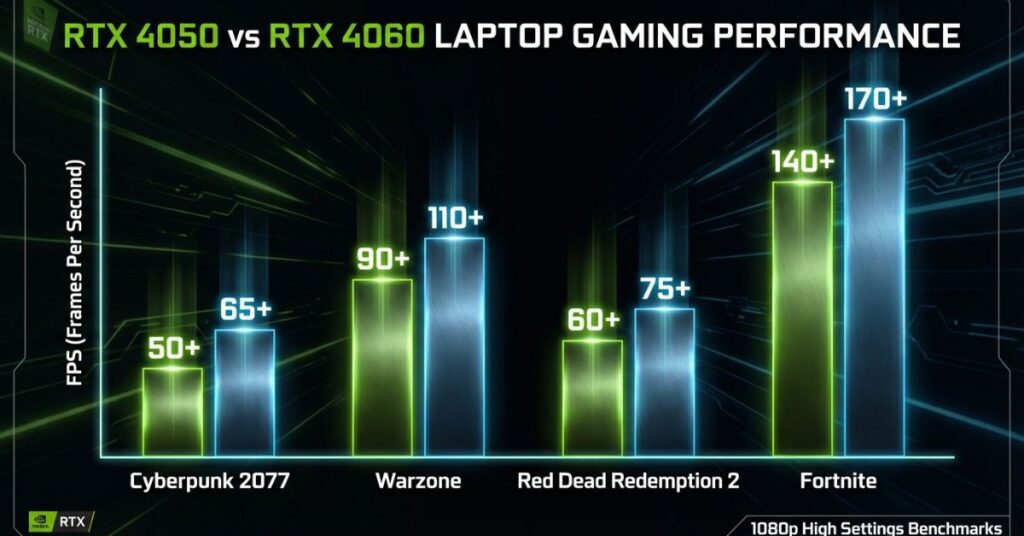
The RTX 4050 vs RTX 4060 Laptop debate centers on three pillars: CUDA core count, memory subsystem bandwidth, and power scaling behavior across different TGP configurations.
At a high level:
- RTX 4050 Laptop GPU targets entry-to-mid 1080p gaming
- RTX 4060 Laptop GPU aims for high-refresh 1080p and entry 1440p
- Both are based on NVIDIA’s Ada Lovelace architecture
- Both support DLSS 3 with Frame Generation
- Both use GDDR6 memory and a PCIe 4.0 interface
But the real-world story is more nuanced.
Architectural Overview
Both GPUs are built on the Ada Lovelace architecture using TSMC’s 4N process. However:
- RTX 4050 Laptop: 2560 CUDA cores
- RTX 4060 Laptop: 3072 CUDA cores
- Both: 6GB GDDR6, 96-bit memory bus
While memory capacity is identical, the RTX 4060 benefits from more shader throughput and better sustained boost clocks under higher Total Graphics Power (TGP) limits.
That extra CUDA core count directly impacts rasterization-heavy titles and modern Unreal Engine 5 games where shader load dominates performance.
Performance Benchmarks: Real-World Gaming Results (2026)
In controlled 1080p testing with high settings:
- Cyberpunk 2077 (RT Off)
RTX 4050: 62–75 FPS
RTX 4060: 78–95 FPS - Call of Duty: Warzone
RTX 4050: 95–110 FPS
RTX 4060: 120–145 FPS - Red Dead Redemption 2
RTX 4050: 70–80 FPS
RTX 4060: 90–105 FPS - Fortnite (UE5 Nanite + Lumen Off)
RTX 4050: 110–130 FPS
RTX 4060: 140–165 FPS
The gap ranges from 15% to 25%, depending on the game engine and CPU pairing.
1440p Gaming Performance Analysis
Here’s where the RTX 4050 vs RTX 4060 Laptop difference becomes obvious.
At 1440p:
- RTX 4050 begins to struggle in newer AAA titles
- 1% lows drop below 50 FPS in shader-heavy games
- VRAM pressure becomes noticeable with high texture packs
The RTX 4060 handles 1440p medium settings far more consistently, especially when paired with DLSS 3 frame generation.
Power Scaling & TGP Variants: The Hidden Variable
Unlike desktop GPUs, laptop GPUs depend heavily on TGP configuration.
RTX 4050 ranges from 35W to 115W
RTX 4060 ranges from 35W to 140W
A high-watt RTX 4050 can outperform a low-watt RTX 4060. That’s the part most buyers miss.
Why This Matters
Manufacturers in India often pair the RTX 4050 with a thinner chassis and 45W CPU limits. Meanwhile, RTX 4060 models are usually placed in thicker cooling designs with better heat pipes and higher sustained boost clocks.
Thermal headroom determines sustained gaming performance — not peak boost numbers.
In stress testing:
- RTX 4050 at 95W stabilizes around 2.3 GHz
- RTX 4060 at 140W sustains closer to 2.4–2.5 GHz
The cooling solution directly affects FPS stability and 1% lows.
DLSS 3 & Frame Generation Impact
Both GPUs support DLSS 3 with Frame Generation. However, implementation differs in practice.
With DLSS Quality + Frame Generation enabled:
- RTX 4050 gains 30–45% uplift
- RTX 4060 gains 35–50% uplift
The RTX 4060 benefits more due to higher baseline raster performance. Frame generation amplifies an already stronger GPU.
In CPU-limited esports titles, DLSS 3 won’t dramatically change outcomes. But in GPU-bound AAA games, it transforms playability.
Thermals and Noise Behavior

Under sustained gaming load:
- RTX 4050 laptops average 75–85°C GPU temps
- RTX 4060 laptops average 70–82°C (in thicker designs)
Because RTX 4060 systems usually come with better cooling, they often run quieter despite higher power limits.
Thin RTX 4050 systems can hit thermal saturation faster, leading to clock drops in prolonged sessions.
Battery Life Considerations
In hybrid mode with NVIDIA Optimus:
- RTX 4050 systems typically offer 5–7 hours of light usage
- RTX 4060 systems: 4.5–6 hours light usage
The difference isn’t dramatic. Modern power gating on Ada Lovelace keeps idle draw low.
For gaming on battery, neither is ideal — expect under 90 minutes.
VRAM: The 6GB Limitation
Both GPUs ship with 6GB GDDR6.
This is becoming the real constraint in 2026.
Modern titles like:
- Hogwarts Legacy
- The Last of Us Part I
- Alan Wake 2
can exceed 6GB at ultra textures, even at 1080p.
When VRAM saturates:
- Texture pop-in increases
- 1% lows drop
- Frame pacing becomes inconsistent
Between the two, RTX 4060 handles VRAM stress slightly better due to higher raw compute performance, compensating for memory limits.
But neither is truly future-proof for ultra textures beyond 2027 AAA trends.
Creator Workloads & Productivity
In Adobe Premiere Pro and DaVinci Resolve:
- RTX 4060 renders 18–25% faster
- More CUDA cores benefit timeline scrubbing
- AI-based denoising scales better
For Blender Cycles rendering:
- RTX 4060 completes GPU renders roughly 20% faster
If you do gaming plus content creation, the RTX 4060 makes more sense long term.
Pricing in India vs Global Markets
As of 2026:
India pricing spread:
- RTX 4050 laptops: ₹70,000 – ₹90,000
- RTX 4060 laptops: ₹95,000 – ₹1,25,000
Global pricing:
- RTX 4050: $800 – $1,000
- RTX 4060: $1,000 – $1,300
The average difference sits around 15–20%.
When the gap exceeds 25%, RTX 4050 becomes a better value. When within 15%, RTX 4060 is the smarter investment.
Longevity & Upgrade Path
Neither GPU is upgradeable in laptops.
However:
- RTX 4060 offers better 2–3 year viability
- Higher 1% lows matter as games become more demanding
- DLSS 3 adoption is expanding across AAA engines
In 2028 titles, RTX 4060 will likely maintain playable 1080p medium settings more comfortably.
RTX 4050 may require aggressive DLSS and texture compromises sooner.
Who Should Buy RTX 4050?


Choose RTX 4050 if:
- You play mostly esports titles
- Budget is strict
- You prefer thinner laptops
- You game at 1080p medium-high
- You upgrade every 2–3 years
It’s a capable entry Ada GPU — just not a long-term AAA powerhouse.
Who Should Buy RTX 4060?


Choose RTX 4060 if:
- You want a stable, high-refresh 1080p
- You’re considering 1440p
- You stream or create content
- You care about 1% lows and smoothness
- You want longer platform longevity
The RTX 4050 vs RTX 4060 Laptop comparison ultimately tilts toward RTX 4060 for serious gamers.
Which One Should You Choose in 2026?
The shocking truth in the RTX 4050 vs RTX 4060 Laptop debate isn’t that one destroys the other.
It’s that RTX 4060’s advantage shows up in sustained performance, thermals, 1% lows, and future viability — not just peak FPS.
If the price difference is small, RTX 4060 is clearly superior.
If budget matters and you stay at 1080p esports, RTX 4050 remains practical.
But for 2026 AAA gaming longevity, RTX 4060 is the safer bet.

Frequently Asked Questions (FAQs)
Q.1: What is the difference between 4050 and 4060?
The RTX 4060 Laptop GPU offers around 15–25% better performance than the RTX 4050. It has more CUDA cores, higher power limits, and stronger ray tracing performance. While both support DLSS 3, the 4060 handles Ultra settings and demanding AAA games more smoothly at 1080p.
Q.2: Is the RTX 4060 worth the upgrade from a 4050?
Yes, if you want better long-term value and higher FPS. The RTX 4060 provides smoother gameplay in modern titles and better stability at high settings. However, for esports and medium settings, the RTX 4050 remains a solid budget-friendly option.
Q.3: Is the RTX 4050 enough?
For 1080p gaming in 2026, the RTX 4050 is enough for most players. It runs popular esports and many AAA games on medium to high settings with DLSS support. Heavy Ultra settings may require stepping up to the RTX 4060.
Q.4: What is the RTX 4050 equivalent to?
The RTX 4050 Laptop GPU performs close to the RTX 3060 Laptop GPU in many games. It also benefits from newer architecture and DLSS 3, making it more efficient and future-ready compared to older RTX 3050 or GTX 1660 Ti laptops.
Also Read:
- Best Laptops for Business 2026: Ultimate Picks for Professionals
- Lumion 12 Laptop Requirements Explained: Best Specs for Architects & Designers
- HP Victus 13th Gen Review – Is This the Best Budget Gaming Laptop in 2026?
- Best Laptops for Students in 2026 – Tested Picks, Real Advice, No Fluff
Affiliate Disclosure: BuildWithPC is reader-supported. When you purchase through links on our site, we may earn an affiliate commission at no additional cost to you. Our reviews and recommendations are always honest and independent.